What Are You Actually Hearing During a Sound Bath?
It can look mystical, but the experience itself is grounded in sound: vibration, resonance, overlapping tones and the way those sounds move through a space.
If you’ve never been to a sound bath, the whole thing can sound a little mysterious.
A room full of people lies down while someone plays crystal singing bowls, a gong and other instruments for the better part of an hour. People often describe feeling deeply relaxed, noticing physical sensations, losing track of time or simply hearing sounds they’ve never paid much attention to before.
But what are you actually hearing during a sound bath?
This isn’t a magic trick. Sound is physical. You hear it through your ears, but vibration can also be felt in the body. A sound bath builds on that sensory experience through sustained tones, resonance, repetition, contrast and silence.
You don’t need to know anything about music theory to experience it. But understanding a little of what’s happening can make the experience feel a lot less abstract.
Crystal singing bowls are musical instruments
Crystal singing bowls are instruments, and each bowl produces a specific fundamental tone along with additional overtones that give the sound more depth and character.
In my set, I work with seven crystal singing bowls tuned to C, D, E, F, G, A and B.
When I play one bowl on its own, you hear that note and the resonance surrounding it. When I begin layering bowls together, those tones interact. That is where the sound starts to become more immersive. Some combinations feel warm and settled. Others feel brighter or create more tension. Certain tones blend easily, while others add contrast. The sound shifts depending on which bowls are played together, how loudly they are played and how much space is left between them. A sound bath is not just a series of bowls being struck one after another. There is a musical relationship happening between the notes.
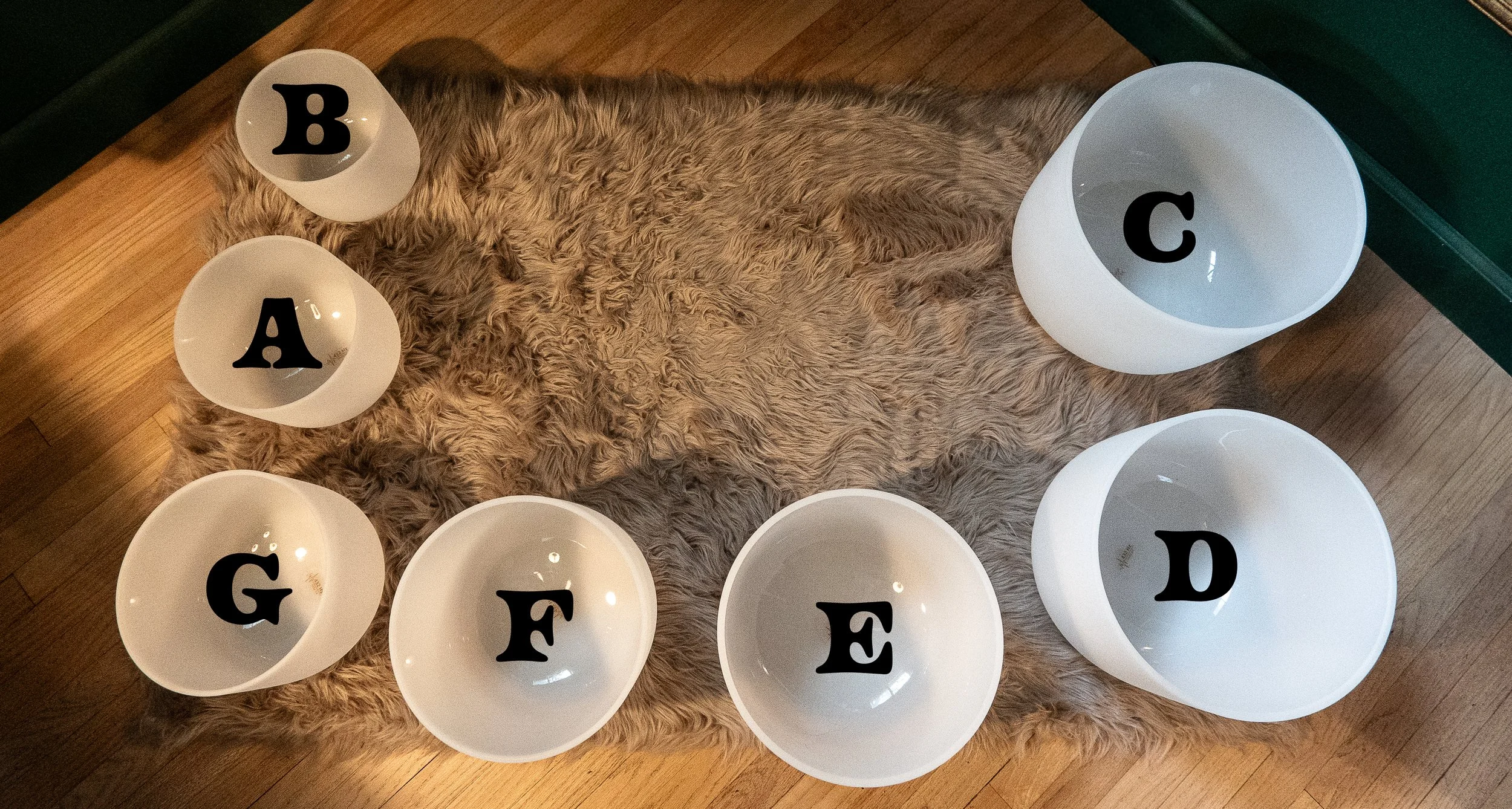
My seven crystal singing bowls are tuned to C, D, E, F, G, A and B. Each note has its own character, and layering them together creates the shifting tones, resonance and contrast that shape the sound bath experience.
The role each bowl plays in my set
I don’t think of each bowl as having one fixed meaning. I think about how each one functions within the full set and what it contributes to the overall sound.
C: The Foundation
C is one of the deeper, fuller tones in my set. It gives the session a grounded starting point and pairs well with the notes around it.
D: The Bridge
D helps create movement between the lower and brighter tones. I often think of it as a transitional note because of how naturally it connects different parts of the set.
E: The Warmth
E has a rich midrange quality that helps fill out the sound. It adds body without feeling especially heavy or bright.
F: The Center
F sits comfortably in the middle of the set and blends easily with the surrounding notes. It helps create balance when several bowls are being layered together.
G: The Lift
G has a clearer, brighter quality than the lower bowls. It adds contrast and can make the soundscape feel more open.
A: The Brightness
A brings even more definition and texture. Because it sits higher in the set, it can stand out more when paired with deeper bowls.
B: The Edge
B is one of the brightest tones I work with. It can create a little more tension and contrast, especially before returning to lower, fuller notes. These descriptions aren’t rules. They’re simply how I hear and use the bowls within my own set. Someone else may experience those same notes differently.
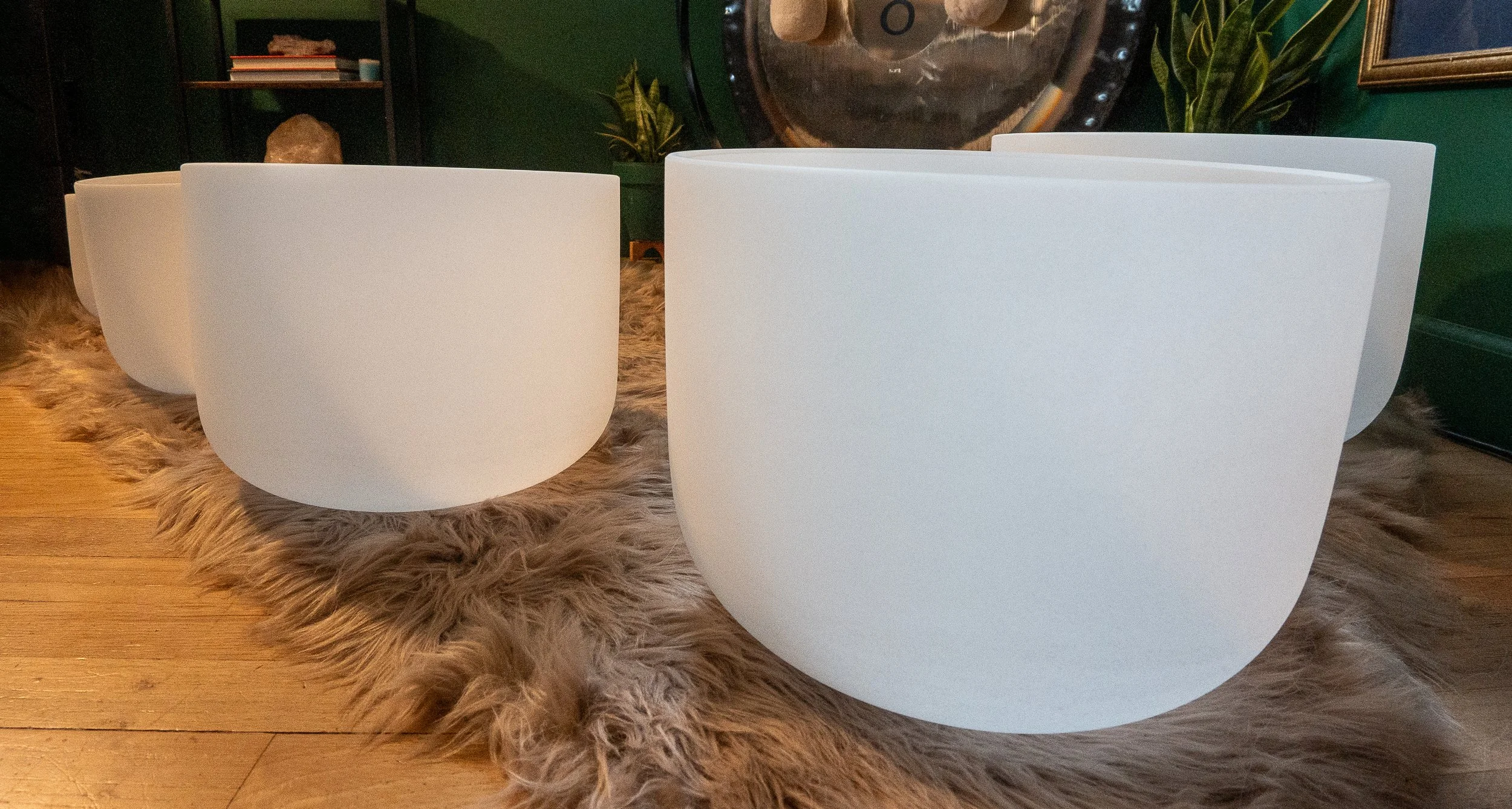
Each instrument adds something different to the room, from the clear sustained tones of the crystal singing bowls to the layered resonance of the gong.
You’re hearing more than a single note
One of the reasons crystal singing bowls can sound so different from familiar instruments is that the tones sustain. When a bowl continues ringing and another bowl is introduced, the previous sound hasn’t fully disappeared yet. The tones begin to overlap. That overlap can create additional frequencies, changing textures and moments where the sound seems to shift even though the bowls themselves haven’t changed.
You may notice a humming, pulsing or wavering quality in the room. You may hear one tone very clearly and then suddenly become aware of another layer underneath it. That is part of what makes a sound bath feel immersive. There isn’t always one melody or rhythm asking for your attention. Instead, you’re surrounded by layers of sound that are constantly changing.
Harmony, tension and contrast all matter
Not every moment in a sound bath is designed to sound perfectly smooth. If everything stayed soft, predictable and harmonious for an hour, the experience could become flat. Contrast gives the ear something to respond to. A fuller combination of bowls can be followed by a single sustained note. A brighter tone can sit against something deeper. The gong can completely change the texture of the room before the bowls return.
There can also be intentional moments of tension before the sound resolves into something more settled. Those movements are part of the experience, however the quieter moments matter too. Silence gives the previous sound somewhere to go. It also gives you a moment to notice what is still resonating in the room after an instrument stops being played.
A sound bath has an arc
I don’t approach a session by randomly choosing bowls for 45 minutes. There is an arc. After spending more than 15 years working in video, I probably shouldn’t be surprised that I think about sound baths in terms of pacing and story. A session needs somewhere to begin, somewhere to build and somewhere to land.
I usually start by giving people time to settle in and adjust to the environment. From there, the sound gradually becomes fuller and more layered. The middle of the session may include more movement, contrast or intensity. Toward the end, I begin creating more space and allowing the sound to soften. The goal isn’t to force someone into a particular emotional state. It is to create an environment where they can stop actively doing for a little while and simply listen.
Where does the gong fit in?
Crystal singing bowls make up most of my sound baths, but the gong serves a very different purpose. My gong, Chiron, has a much broader and less predictable range of sound. Where a singing bowl gives me a clearer fundamental tone, the gong can produce layers of low rumbling tones, brighter metallic sounds and complex overtones all at once.
It changes depending on where it is played, how it is struck and how much energy is used. Because of that, I often use the gong as a shift in the session rather than simply treating it like another bowl. It changes the texture of the room. And because the sound is so layered, different people may focus on completely different parts of it.
What about chakras and frequencies?
This is usually where conversations about sound baths can go in very different directions. There are spiritual and modern wellness practices that associate certain notes, bowls and frequencies with chakras, energy centers and other forms of energetic work. That framework is meaningful to many people.
I don’t think it needs to be dismissed simply because it is difficult to measure or because someone else relates to sound differently. At the same time, you do not need to believe in chakras, energy work or any particular spiritual system to participate in a sound bath.
You can experience the session through music, vibration and sensory awareness, approach it from a spiritual perspective, or find meaning in both. My goal is not to tell someone what they are supposed to believe about what they are hearing. I would rather create the space and let people notice what they notice.
Why can a sound bath feel so immersive?
Part of the answer is simple: you are giving your attention to sound for an extended period of time without needing to respond to it. There are no lyrics to follow, no screen to watch and no conversation you need to participate in. You can close your eyes, get comfortable and let the sound unfold around you.
The sustained tones, repetition, vibration, changes in volume and overlapping sounds create a sensory experience that feels very different from the constant stimulation most of us move through during a normal day. Because sound travels through the room, the experience is not limited to what you hear through your ears. Depending on the instrument, the space and where you are positioned, you may also physically feel some of the vibration. In that sense, a sound bath can be a somatic experience: something you experience through the body, not just something you process intellectually.
You can just listen
Understanding the musical structure behind a sound bath can make the experience more interesting, but none of that knowledge is required to participate. You do not need a background in music, experience with meditation or a particular spiritual belief system to get something out of it.
For me, learning more about the relationship between notes, resonance, overtones and vibration has only deepened my appreciation for what these instruments can do. There is a surprising amount happening within a sound that can seem simple at first.
But when you are actually in the room, you do not need to identify the notes, follow the progression or figure out why a certain sound feels the way it does. The explanation can stay in the background. You can get comfortable, let the sound move through the space and experience it in whatever way feels natural to you.