How Powerful Is Sound? From Sonic Weapons to Medicine and Fire Suppression
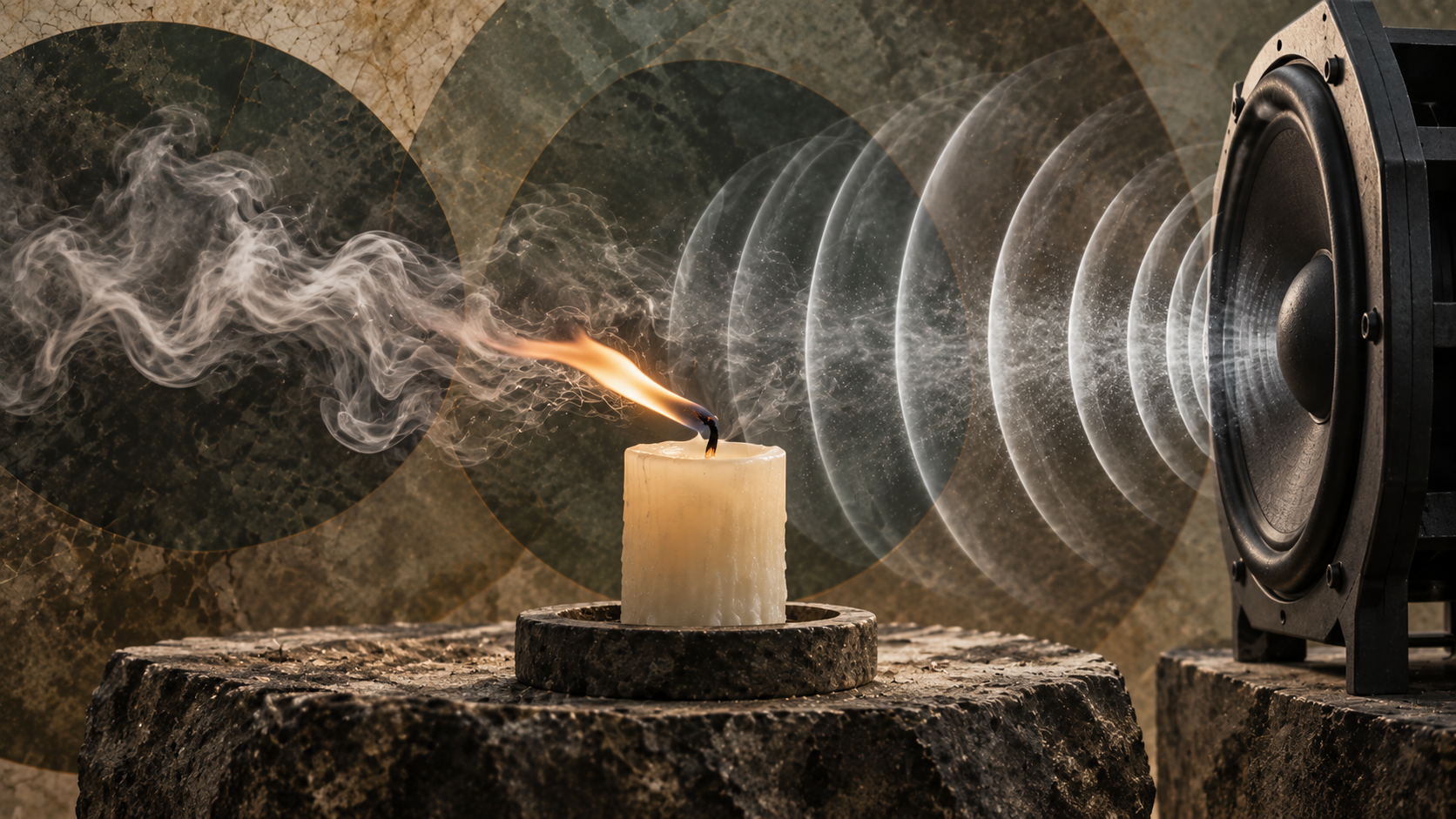
Sound can break apart a kidney stone without a surgeon making an incision. It can be focused tightly enough to destroy targeted tissue. At high enough intensities, it can permanently damage hearing. Under the right experimental conditions, low-frequency sound can even extinguish a flame.
Those sound like completely unrelated facts, but they all come back to the same basic idea: sound is physical.
We usually think about sound in terms of what we hear: music, conversation, traffic, a dog barking or a singing bowl ringing across a room. Hearing is only part of what is happening, though. Sound begins with vibration, and those vibrations create pressure changes that travel through a material such as air, water or tissue.
According to the National Academies, sound consists of pressure variations created by vibrating objects and transmitted through a medium. When those pressure waves reach another object, some of that vibrational energy can be transferred to it.
That is already happening every time you hear something. Sound waves enter the ear, vibrate the eardrum, move tiny bones in the middle ear and eventually create movement in the fluid inside the cochlea. Specialized cells convert that movement into electrical signals that travel to the brain.
Sound is not an invisible idea floating through a room. It is mechanical energy traveling through matter.
What gets really interesting is how dramatically the outcome can change depending on how that energy is produced and delivered.
Sound can physically damage the body
This is probably the least surprising example because most of us already know loud noise can damage our hearing. What is interesting is just how physical that damage can be.
The National Institute for Occupational Safety and Health, or NIOSH, recommends limiting workplace exposure to an average of 85 dBA over an eight-hour workday. Both intensity and duration affect the risk, which means louder sounds can become hazardous much more quickly.
Impulse noise is particularly intense. Think gunshots, explosions or other sudden pressure changes. NIOSH researchers Chucri Kardous and William Murphy have written that high-intensity impulse noise can cause instant mechanical damage to the inner ear, with some impulses from firearms and fireworks reaching peaks around 170 to 180 decibels or higher.
That brings us to one of the stranger uses of acoustics: using sound as a deterrent.
Can sound actually be used as a weapon?
Yes, although the term “sonic weapon” can make the subject sound more science fiction than it needs to be.
Acoustic hailing devices, including systems commonly referred to as LRADs, were originally developed as long-range communication systems. Rather than spreading sound broadly like a typical speaker, they can project sound much more directionally over considerable distances.
The Acoustical Society of America notes that these devices were developed for military communication and can produce dangerously high sound levels when used at shorter distances. The organization has warned about the potential for permanent hearing loss and called for strict limits on intensity and exposure duration when the systems are used for crowd control.
There is no mysterious frequency secretly switching off the human body. The physical mechanism is much easier to understand: a large amount of acoustic energy is being directed toward a particular area.
Conversations about “sound weapons” can easily wander into claims that are much harder to support, even though we already have a well-established explanation for how intense sound can hurt someone. Powerful pressure waves can overwhelm and damage the auditory system.
Sound does not have to be harmful to have a measurable physical effect, though. Medicine has learned how to use acoustic energy with remarkable precision.
Doctors use sound to see inside the body
Most of us are familiar with ultrasound imaging, even if we do not immediately think of it as sound.
Ultrasound simply refers to acoustic frequencies above the range of normal human hearing. According to the National Institute of Biomedical Imaging and Bioengineering, diagnostic ultrasound transducers commonly operate in the megahertz range and send high-frequency sound into the body. Those waves interact with tissue, and the returning information can be converted into an image.
We do not need to hear a sound for it to physically interact with the body.
Ultrasound can also do much more than create pictures.
Sound can be focused strongly enough to destroy tissue
Therapeutic ultrasound uses acoustic energy very differently from the ultrasound used for imaging.
The National Institute of Biomedical Imaging and Bioengineering explains that therapeutic ultrasound can be used to move or push tissue, heat tissue, help dissolve blood clots and deliver medication to specific areas.
High Intensity Focused Ultrasound, commonly called HIFU, goes further by concentrating acoustic energy onto a carefully selected target. Enough energy can be focused into that small area to heat or destroy tissue without requiring a surgical incision through the skin.
One way to picture the concept is a magnifying glass concentrating sunlight. The energy is not spread evenly across a large area anymore. It is focused onto a much smaller point. NIBIB has used a similar analogy when explaining focused ultrasound research involving the brain.
This is also a good example of why the statement “sound affects the body” can be completely true while still telling us very little on its own.
The physical outcome depends on the characteristics of the sound, how much energy is involved, where that energy is directed and how long the exposure lasts.
A medical ultrasound device and a crystal singing bowl both produce acoustic waves. That does not make their effects interchangeable.
Acoustic waves can break apart kidney stones
There is another medical application that feels almost impossible until you remember that sound can transfer mechanical energy.
Shock wave lithotripsy is used to break kidney stones into smaller pieces so they can pass through the urinary tract. The treatment is performed from outside the body. A lithotripter generates focused shock waves that travel through tissue and deliver enough mechanical stress to fragment the stone.
Again, this is not the same thing as playing a loud sound through a speaker. Shock waves have particular pressure characteristics and are created using specialized medical equipment.
What makes the example so interesting is how clearly it demonstrates the difference engineering can make. Acoustic energy can behave very differently when it is produced, focused and delivered for a specific purpose.
Sound can even move physical objects
Researchers can also use sound to manipulate matter without touching it.
Acoustic levitation uses forces created by carefully controlled sound fields to counteract gravity and suspend small objects in the air. Researchers have used the technique with solid objects, liquid droplets and other materials.
A review by Marco Aurélio Brizzotti Andrade, Nicolás Pérez and Júlio Cezar Adamowski describes how acoustic radiation forces can be used not only to suspend objects but also to rotate and move them through three-dimensional space.
There is something useful about actually seeing sound move an object. We cannot watch a pressure wave travel across the air with our eyes, but acoustic levitation makes the forces created by those waves much easier to appreciate.
Which brings us to fire.
Yes, researchers have extinguished flames with sound
This one sounds like something somebody made for YouTube, but acoustic fire suppression is a real area of research.
In a 2024 study published in Applied Sciences, researchers Valentyna Loboichenko, Grzegorz Wilk-Jakubowski, Jacek Lukasz Wilk-Jakubowski and Jozef Ciosmak tested low-frequency acoustic waves against candle flames. Their laboratory system used a high-powered woofer, amplifier and signal generator. Under the right conditions, both modulated and unmodulated low-frequency waves were able to extinguish the flames.
The scale is important here. They were extinguishing candle flames in a laboratory, not replacing a fire department with a giant subwoofer.
A 2025 review by Xinyue Shi, Zhaojun Tian, Yi Lu and Qing Ye examined the broader field of acoustic fire suppression. The researchers found that low-frequency sound, particularly around 40 to 80 Hz in the systems they reviewed, can destabilize combustion through airflow disturbances. Sound pressure, frequency and waveform all influenced how effectively the flame was disrupted.
So yes, sound really can put out a flame, but that statement only becomes useful when we understand the conditions behind it.
A low-frequency tone by itself is not a fire extinguisher. The physical effect comes from a specific combination of sound, equipment, pressure, distance, waveform and the type of flame being studied.
The same caution applies when we talk about sound and the human body.
There is no single “effect of sound”
This is where conversations about sound therapy, sound healing and sound baths can become confusing.
Scientific research gives us extraordinary examples of sound breaking materials, altering tissue, moving objects, damaging hearing and extinguishing flames. Those examples show what acoustic energy is capable of under particular conditions. They do not demonstrate that every frequency has a particular therapeutic effect.
A 40 Hz acoustic fire suppression system is not doing the same thing as a 40 Hz tone quietly played through headphones. Focused medical ultrasound is not doing the same thing as a gong. A shock wave engineered to break a kidney stone is not comparable to feeling the vibration of a singing bowl across a room.
Sharing the word frequency does not make those experiences equivalent.
That does not make ordinary sound uninteresting. I think it actually gives us a much better starting point for asking what sound may be doing.
What do we actually know about sound and health?
There is a much larger body of research examining music and health than there is specifically examining sound baths.
The National Center for Complementary and Integrative Health reports that music-based interventions have been studied in relation to pain, anxiety, stress, depression, rehabilitation and other health outcomes.
A 2020 systematic review and two meta-analyses led by Martina de Witte examined 104 studies involving 9,617 participants and found beneficial effects on physiological and psychological measures associated with stress. The size of those effects varied, and the interventions themselves were diverse.
Research does not suggest that music is universally therapeutic or that every sound produces the same predictable biological response. Findings depend on what is being studied, who is participating, how the sound or music is being used and which outcomes researchers are measuring. Even research involving areas such as sleep has produced mixed results.
Sound can influence us without needing to be treated like medicine.
We respond to rhythm, volume, repetition, silence, expectation, memory and changes in our environment. Hearing itself requires the brain to continuously interpret physical vibrations arriving through the auditory system.
That already gives researchers plenty to explore.
What about singing bowls and sound baths?
Research specifically involving singing bowls is growing, but it is nowhere near the level of evidence behind established medical uses of ultrasound.
In 2020, researchers Jessica Stanhope and Philip Weinstein reviewed the available peer-reviewed research on singing bowls and found only four eligible studies. Although those studies reported several promising changes in psychological and physiological measures, the researchers concluded that the small number of studies and potential methodological bias meant there was not enough evidence to make clinical recommendations.
The research base has expanded since then.
A 2025 systematic review led by Yiqing Cai identified 19 clinical studies from eight countries, including nine randomized controlled trials. Researchers found potential benefits involving anxiety, depression, sleep and several physiological measurements, while also noting substantial variation in how singing bowls were used and studied.
An earlier observational study led by Tamara Goldsby at the University of California, San Diego followed 62 people participating in a Tibetan singing bowl meditation. Participants reported lower tension, anger, fatigue and depressed mood after the session.
Because it was an observational pre-post study rather than a controlled clinical trial, it cannot tell us how much of that change was caused specifically by the bowls themselves.
For me, that is where the conversation around sound bath benefits becomes much more interesting.
We do not have to leap from “people often feel deeply relaxed during a sound bath” to claims that a particular frequency is healing cells or treating a medical condition. There is a lot of room between those two ideas.
During a sound bath, physical sound waves are entering the auditory system. Different frequencies and overtones overlap. Volume rises and falls. Attention shifts toward an evolving sensory environment. Lower-frequency vibration may be physically noticeable, particularly from instruments such as a gong.
At the same time, you may be lying or sitting comfortably for an extended period while very few demands are being placed on your attention.
Those are all real parts of the experience, even while researchers continue figuring out how they interact and what measurable effects they may have.
Sound is powerful, but context is everything
I originally became interested in this question because the word sound covers an absurd amount of territory.
It can describe a conversation across a table, a concert loud enough to damage your hearing, ultrasound creating an image of a baby, focused acoustic energy treating tissue, a shock wave breaking a kidney stone, low-frequency waves destabilizing a flame or a singing bowl resonating across a quiet room.
The same basic physics sits underneath all of them, yet the outcomes can be dramatically different.
That is one of the reasons I find sound baths interesting without needing to exaggerate what they do.
There is already something pretty incredible happening before we add any bigger claims. An instrument vibrates. Those vibrations create pressure changes in the air. The wave moves across the room and reaches your ear, where physical movement is eventually converted into electrical signals. Your brain then turns those signals into the experience we call sound.
Some sounds alert us. Some irritate us. Some can damage us. Some are used as precise medical tools. Others become music, memory, atmosphere or an opportunity to rest.
Understanding the physics does not have to take anything away from the meaning we find in the experience.
Sound can be understood scientifically while still leaving room for experiences that feel personal, emotional or spiritual. Science can help explain part of what is happening without needing to define every part of what someone feels, and those perspectives do not have to cancel each other out.
For me, that makes sound more interesting, not less.